

Digital ad spending is on track to surpass $800 billion by 2025, creating an intensely competitive ecommerce landscape. If you are an ecommerce leader or marketer, you are probably feeling the squeeze of rising customer acquisition costs and crowded ad spaces. Now, more than ever, you need strategies that deliver measurable ROI.
That is where performance marketing ecommerce comes in. This approach empowers you to focus on data-driven, results-oriented growth, even as the industry evolves into 2026.
In this comprehensive guide, you will discover the latest strategies, key metrics, and essential channels to help your ecommerce brand thrive. Expect clear, actionable steps and best practices designed to future-proof your performance marketing ecommerce strategy.
Understanding Performance Marketing in Ecommerce
Curious about how brands are thriving in today’s competitive online world? The secret often lies in performance marketing ecommerce strategies. Forget the guesswork of old-school advertising. This approach lets you track every click, sale, and lead, making your marketing as accountable as your inventory. Let’s break down what sets performance marketing ecommerce apart and why it’s becoming the go-to method for ambitious brands.

What is Performance Marketing?
Performance marketing ecommerce is all about paying for results, not just exposure. Instead of throwing money at TV or print ads and hoping for the best, you only pay when specific actions happen, like a sale or a click. This model aligns perfectly with ecommerce, where every dollar counts and growth needs to be measurable.
For example, traditional advertising often leaves you wondering if your investment paid off. With performance marketing ecommerce, you can see exactly what you got for your spend. As brands pour more into digital ads, performance-based models are rising fast, letting you scale up with confidence.
How Performance Marketing Differs from Traditional and Digital Marketing
So, what’s the real difference between performance marketing ecommerce and other marketing types? While digital marketing may focus on impressions or brand awareness, performance marketing is laser-focused on actions. You’ll encounter pay-for-result models like CPM (cost per thousand views), CPC (cost per click), CPL (cost per lead), CPS (cost per sale), and CPA (cost per acquisition).
Here’s a quick comparison:
| Model | Traditional | Digital | Performance Marketing Ecommerce |
|---|---|---|---|
| Main Focus | Brand awareness | Impressions, traffic | Measurable actions |
| Payment | Upfront | Upfront or ongoing | Only for results |
| Example | TV ad slot | Banner ad | Paid only for conversion |
In essence, you’re paying for what matters—conversions and growth.
Benefits for Ecommerce Businesses
Why are so many brands shifting to performance marketing ecommerce? The benefits are hard to ignore.
- Budget efficiency: Only pay for results, so there’s less wasted spend.
- Real-time optimization: See what’s working and adjust on the fly.
- Enhanced planning: Clear metrics make campaign management easier.
- Lower risk: Payment models reduce financial uncertainty.
Imagine a DTC brand scaling rapidly by doubling down on channels where every dollar spent brings in measurable revenue. That’s the power of performance marketing ecommerce in action.
Key 2026 Trends Shaping Ecommerce Performance Marketing
Looking ahead, performance marketing ecommerce is evolving fast. The rise of omnichannel and mobile commerce means you need to track customers across devices seamlessly. AI and automation are making targeting and bid optimization smarter than ever.
Privacy changes, like cookie deprecation and new data regulations, are shaking up how you track results. New platforms such as TikTok and emerging social networks are opening fresh performance channels. And if you want your campaigns to stand out, personalized, data-driven creative assets are essential. For a broader look at what’s next, check out these Performance Marketing Strategies for 2026.
Essential Performance Marketing Channels for Ecommerce in 2026
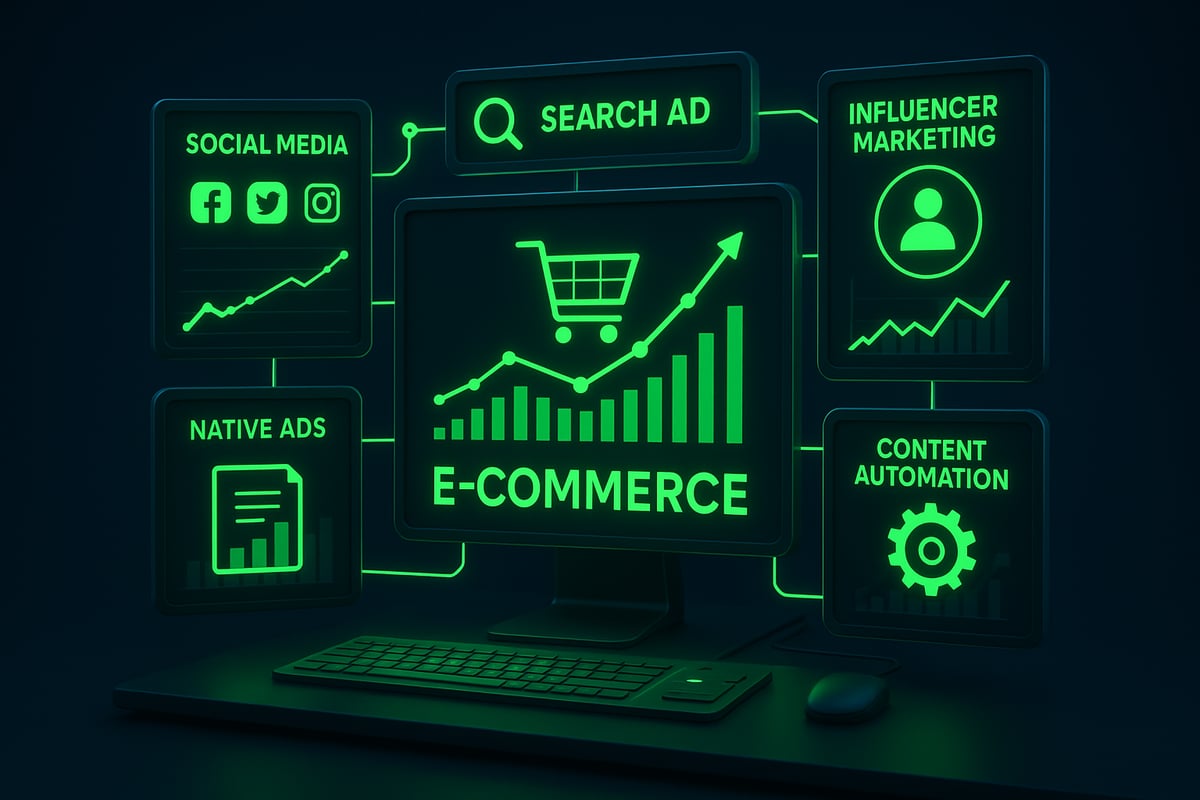
The digital landscape is evolving at lightning speed, and knowing where to focus your efforts can feel like choosing a path in a maze. To win at performance marketing ecommerce in 2026, you need to master the right channels—those that deliver measurable results and adapt to consumer behavior. Let’s break down the top five channels you can’t afford to ignore.
Social Media Advertising
Social media remains a powerhouse for performance marketing ecommerce. Platforms like Facebook, Instagram, TikTok, Pinterest, and LinkedIn offer advanced targeting, retargeting, and shoppable post features that let you reach buyers at every stage of their journey.
Did you know there are over 4.62 billion social media users worldwide, with projections reaching 6 billion by 2027? That’s a massive audience ready to engage. Instagram Shops, for example, make it seamless to convert browsers into buyers directly in-app.
Optimizing your ad spend is crucial as platforms evolve. If you’re curious about how adjusting your budget can impact results, check out this deep dive on Facebook ad budget impact.
Search Engine Marketing (SEM)
When shoppers are ready to buy, they search. SEM puts your products front and center on Google Ads, Bing Ads, and even emerging AI-driven search engines. Paid search and shopping ads are the bread and butter for performance marketing ecommerce, enabling you to capture high-intent traffic.
Pairing SEM with strong organic SEO creates a holistic approach, amplifying your visibility. Google Shopping campaigns, in particular, streamline product discovery and drive direct sales with just a few clicks.
For the best results, combine paid and organic strategies, ensuring you cover every touchpoint where buyers are searching.
Affiliate and Influencer Marketing
Affiliate and influencer marketing is your secret weapon for expanding reach without blowing your budget. By partnering with affiliates, creators, and influencers, you only pay for results—think CPA (cost per acquisition) or CPS (cost per sale).
Micro-influencers are especially valuable for performance marketing ecommerce. They connect with niche audiences, driving authentic engagement and quality conversions. As influencer marketplaces and tracking tools improve, managing these partnerships becomes even easier.
Trends for 2026 point toward smarter, performance-based collaborations that boost ROI and brand trust at the same time.
Native and Display Advertising
Native and display ads are evolving rapidly. Native ads blend into the content your audience already loves, increasing purchase intent by 18 percent. Display ads, meanwhile, are ideal for retargeting and brand awareness, especially when creative formats fight off ad fatigue.
Programmatic display campaigns powered by AI allow real-time optimization, helping you reach the right people at the perfect moment. Did you know native ads get 53 percent more views than traditional display ads? That’s a game-changer for performance marketing ecommerce.
Experiment with creative formats to keep your messaging fresh and engaging.
Content Marketing & Automation
Content marketing is no longer just about blogs—it’s about performance-driven assets like product guides, reviews, and interactive experiences. Automation tools handle segmentation, personalization, and campaign management so you can scale without losing the human touch.
For performance marketing ecommerce, automated email and SMS workflows triggered by user behavior drive timely, relevant engagement. Imagine a customer abandoning their cart and instantly receiving a personalized reminder—simple, effective, and proven to increase conversions.
With 82 percent of marketers investing in content marketing, automation is now the standard for staying ahead.
Building a High-Impact Ecommerce Performance Marketing Strategy: Step-by-Step
Ready to take your performance marketing ecommerce game to the next level? Let’s break down the process into eight actionable steps. Whether you’re just starting out or looking to scale, following this step-by-step approach ensures you’re not leaving growth to chance.

Step 1: Define Clear, Measurable Goals
The first step in any effective performance marketing ecommerce strategy is setting goals that are crystal clear and measurable. Vague ambitions like “grow sales” won’t cut it. You need to be specific.
A great tool here is the SMART framework. Here’s what it looks like in action:
| Goal Element | Example |
|---|---|
| Specific | Increase conversion rate |
| Measurable | By 20% |
| Assignable | Marketing team |
| Realistic | Based on last quarter’s growth |
| Time-bound | By the end of Q1 |
Why is this so important? Having precise targets lets you track every dollar spent in your performance marketing ecommerce campaigns and see exactly what’s working.
Step 2: Deeply Understand and Segment Your Target Audience
Knowing your audience is the heart of performance marketing ecommerce. It’s not enough to target “shoppers aged 18-35”—dig deeper.
Start by building detailed buyer personas using your existing customer data. Consider demographics, psychographics, and purchase behaviors. Are some customers coming back to buy again and again? Segment them for loyalty campaigns.
Tools like Google Analytics and CRM platforms help you slice your data for hyper-targeted messaging. When you understand your audience this well, your performance marketing ecommerce campaigns can reach the right people at the right time.
Step 3: Select and Prioritize the Right Channels
Not every channel is created equal in performance marketing ecommerce. You want to be where your audience hangs out and where your budget works hardest.
Match your buyer personas to the right channels. For example, Gen Z may be scrolling TikTok, while professionals check LinkedIn. Don’t forget to analyze cost-per-click (CPC) and customer acquisition cost (CAC) for each channel.
An omnichannel approach often delivers the best results, synchronizing campaigns across Google Shopping, Facebook Ads, and even influencer partnerships. The key to performance marketing ecommerce is smart allocation, not just spreading your budget thin.
Step 4: Optimize Your Ecommerce Website for Conversions
You can drive all the traffic in the world, but if your site isn’t built to convert, you’re losing money. Performance marketing ecommerce thrives on seamless, user-friendly experiences.
Focus on mobile responsiveness, fast load times, and intuitive navigation. Streamline your checkout process and use high-quality images and persuasive calls-to-action. Want to dive deeper into boosting your site’s effectiveness? Check out this guide on Understanding conversion rate optimization for more actionable tips.
Remember, every improvement here amplifies your performance marketing ecommerce ROI.
Step 5: Craft High-Converting Creative and Messaging
Your ads need to stand out and speak directly to your audience’s needs. In performance marketing ecommerce, it’s not just about flashy visuals—it’s about messaging that drives action.
Write ad copy that highlights benefits, not just features. Tap into emotional triggers and use social proof like reviews or testimonials. Align your creative assets with your campaign objectives and landing pages.
A/B testing is your friend here. Try different headlines, images, or offers to see what truly resonates. Small tweaks in creative can lead to big wins in performance marketing ecommerce.
Step 6: Launch, Track, and Optimize Campaigns
Launching your performance marketing ecommerce campaign is just the start. The real magic happens in tracking and optimization.
Implement robust tracking with UTM parameters, conversion pixels, and APIs. Here’s a sample UTM parameter:
utm_source=facebook&utm_medium=cpc&utm_campaign=spring_sale
Monitor performance in real time. Use automation tools for bid management and budget allocation. Shift spend from underperforming ads to those driving results. Your performance marketing ecommerce strategy should never be “set and forget.”
Step 7: Continuous Testing and Iteration
Testing isn’t a one-time event—it’s a mindset. In performance marketing ecommerce, continuous A/B and multivariate testing helps you stay ahead of competitors.
Experiment with ads, landing pages, and even offers. Analyze your data to find what’s working and scale up those tactics. Don’t be afraid to learn from campaigns that flop—each failure brings insights for next time.
Try testing ad scheduling to see if conversions spike during certain hours. The ongoing cycle of testing is what fuels long-term performance marketing ecommerce growth.
Step 8: Leverage Data for Personalization and Retention
The final step in your performance marketing ecommerce strategy is turning data into lasting customer relationships. Use campaign data to personalize messages and offers for different segments.
Build loyalty programs and automate post-purchase engagement, such as personalized product recommendations based on browsing or purchase history. These efforts boost retention and increase lifetime value.
Performance marketing ecommerce isn’t just about acquiring new customers—it’s about creating loyal fans who keep coming back.
Advanced Optimization Techniques for 2026 Ecommerce Performance Marketing
Ready to supercharge your performance marketing ecommerce results in 2026? Let’s dig into the advanced optimization techniques that will keep you ahead of the competition. These strategies are designed to help you unlock growth, boost ROI, and create seamless customer experiences at every touchpoint.
Harnessing AI and Automation
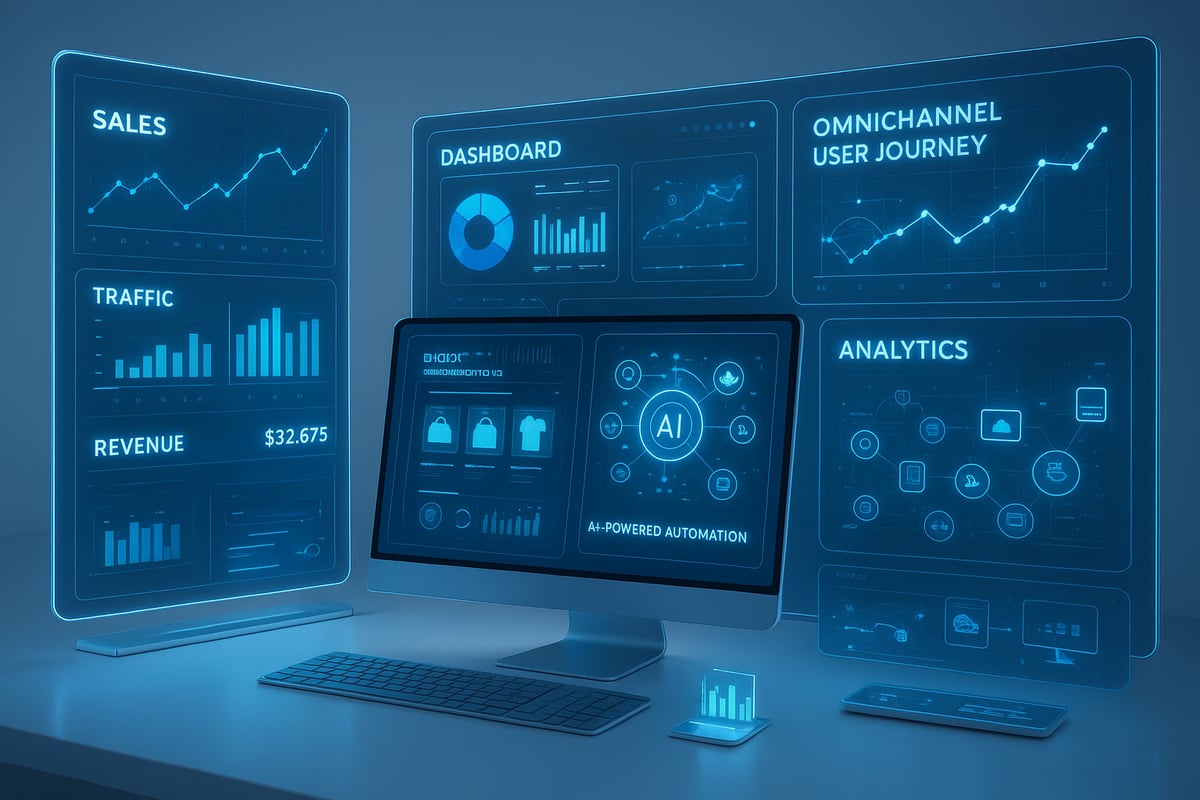
Artificial intelligence is revolutionizing performance marketing ecommerce by automating complex tasks and making smarter, faster decisions. AI algorithms can now predict audience behavior, optimize bids in real time, and even generate ad creatives tailored to individual users.
For example, marketers are using predictive analytics to identify shoppers most likely to convert, then automatically adjusting budgets and creative assets to target them. Automation tools handle campaign management, freeing up your team to focus on strategy.
Want to go deeper? Check out these AI Marketing Automation Trends 2026 to see how leading brands are leveraging these innovations for performance marketing ecommerce.
Navigating Privacy and Attribution Challenges
With privacy regulations tightening and third-party cookies disappearing, performance marketing ecommerce faces new attribution challenges. Adapting to these changes means shifting toward first-party data and consent-based tracking.
Server-side tracking and conversion APIs are essential for capturing customer actions across channels. Consent management platforms help ensure compliance while maintaining data quality.
Ecommerce businesses must refine attribution models, using solutions that respect privacy while still delivering actionable insights. This balance is critical for sustaining long-term growth in performance marketing ecommerce.
Omnichannel and Cross-Device Measurement
Today’s customers move seamlessly between devices and platforms, so tracking their journeys is crucial for performance marketing ecommerce. Omnichannel measurement means integrating data from web, mobile apps, and even in-store touchpoints.
Connect your CRM and analytics tools to create a unified customer view. Advanced attribution models, like data-driven or linear attribution, consider every interaction before a conversion.
By understanding how each channel contributes, you can allocate budgets more effectively and optimize campaigns for the full customer journey in performance marketing ecommerce.
Creative Personalization at Scale
Personalized experiences drive higher engagement and conversions in performance marketing ecommerce. Dynamic creative optimization (DCO) lets you serve unique ads, offers, and visuals to different audience segments, all at scale.
For instance, you can show one set of products to returning customers and another to first-time visitors. AI tools make this process seamless, adjusting content based on user preferences and real-time behavior.
The result? More relevant messaging, improved click-through rates, and a stronger connection with your audience in performance marketing ecommerce.
Leveraging Emerging Platforms and Formats
The digital landscape is always evolving, and new platforms offer fresh opportunities for performance marketing ecommerce. TikTok Shop, shoppable livestreams, and AR/VR ads are just a few examples of emerging formats capturing consumer attention.
Experiment with interactive video ads or early adoption of social commerce features. These innovative channels can deliver direct conversions and help you reach audiences where they spend their time.
Staying flexible and open to testing new formats is key to maximizing performance marketing ecommerce growth in 2026.
Integrating Automation Tools for Efficiency
Efficiency is the name of the game in performance marketing ecommerce. Marketing automation tools streamline audience segmentation, ad scheduling, and reporting, so you can focus on strategy and creativity.
For example, automated SMS or email workflows triggered by cart abandonment or product launches keep your brand top of mind. These tools not only save time but also drive higher ROI through timely, relevant communication.
Automation improves campaign performance, making it an essential part of any performance marketing ecommerce toolkit.
Measuring Success: Key Performance Marketing Metrics for Ecommerce
Understanding how to measure your progress is the heartbeat of performance marketing ecommerce. If you want to scale efficiently, you need to know which numbers matter, how to track them, and, most importantly, how to turn raw data into actionable growth. Let’s break down the essentials so you can confidently track your ecommerce campaigns and make smarter decisions.
Core Metrics and KPIs
In performance marketing ecommerce, tracking the right metrics is non-negotiable. Let’s quickly review the heavy hitters:
| Metric | Definition | Use Case |
|---|---|---|
| CPM | Cost per 1,000 impressions | Awareness campaigns |
| CPC | Cost per click | Driving traffic |
| CPL | Cost per lead | Lead generation |
| CPS | Cost per sale | Direct sales focus |
| CPA | Cost per acquisition | Overall efficiency |
For ecommerce, CPA is a go-to metric, revealing how much you pay for each customer gained. Imagine running a Google Shopping campaign and paying only when someone actually buys — that’s the power of performance marketing ecommerce.
Tracking and Attribution Best Practices
Accurate tracking is the foundation of performance marketing ecommerce success. Start with the basics: implement pixels, UTM codes, and server-side integrations to capture every action.
Embrace multi-touch attribution models to understand the full customer journey, not just the last action before purchase. For example, comparing last-click to data-driven attribution can uncover hidden value in upper-funnel channels.
If you’re expanding into SEO or organic channels, check out Performance marketing SEO strategies for tips on integrating search into your performance measurement stack. This holistic view ensures you don’t miss out on any channel’s contribution to your results.
Analyzing and Reporting Performance Data
To get the most from performance marketing ecommerce, set up real-time dashboards that track your KPIs across all channels. Segment your data by traffic source, device, creative, and audience to spot patterns.
- Identify top-performing ads and channels
- Reallocate budget to best performers
- Uncover underperforming segments quickly
For instance, if your Facebook Ads outperform Google Ads in terms of CPA, quickly shift more budget to Facebook. Smart analysis means every dollar works harder.
Benchmarking and Industry Standards
How do you know if your performance marketing ecommerce results are good? Compare your KPIs to industry benchmarks for CTR, CVR, CPA, and ROAS. Use resources like Statista or Oberlo for reliable averages.
| KPI | Industry Average (Example) |
|---|---|
| CTR | 1.5% – 2.5% |
| CVR | 2% – 4% |
| CPA | $20 – $60 |
| ROAS | 4:1 or higher |
If you’re working with a tighter budget, see The impact of lower ad budgets to understand how spending levels can affect your key metrics and ROI.
Using Insights for Continuous Improvement
The real magic of performance marketing ecommerce is in the ongoing optimization. Every month, review your data, run experiments, and document what works.
- Test new creatives and offers
- Adjust targeting based on insights
- Scale up winning campaigns
Build a culture of experimentation so you’re always learning and improving. Over time, these small tweaks can deliver outsized results and help you future-proof your performance marketing ecommerce strategy.
Future-Proofing Your Ecommerce Performance Marketing Strategy
Adapting your performance marketing ecommerce strategy for the future is not just a smart move, it is essential for ongoing growth. The digital marketplace is evolving at lightning speed. To stay ahead, you need to anticipate shifts in consumer behavior, strengthen your data foundation, invest in your team, and build flexibility into every process.
Adapting to Changing Consumer Behaviors
Consumer habits are changing fast. Shoppers now move seamlessly between devices, expect instant access, and are quick to embrace new platforms and payment options. If you want your performance marketing ecommerce efforts to succeed, you must monitor these shifts closely.
Mobile-first experiences and social commerce are on the rise. Voice search and visual search are gaining traction. Are you optimizing your campaigns and website for these new behaviors? Reviewing Global Ecommerce Trends for 2026 can help you spot emerging platforms and technologies, so you can stay one step ahead.
Investing in First-Party Data and Customer Relationships
With data privacy changes, relying on third-party data is becoming riskier. The most successful performance marketing ecommerce brands are doubling down on collecting first-party and zero-party data. This includes building loyalty programs, encouraging email and SMS opt-ins, and creating interactive experiences that invite customers to share preferences.
Personalization is the new standard. By leveraging first-party data, you can tailor offers, content, and messaging to each shopper. You can also explore AI-Powered Personalization in Ecommerce to see how artificial intelligence can enhance your data-driven strategies and deepen customer loyalty.
Staying Ahead with Continuous Learning and Innovation
The performance marketing ecommerce landscape never stands still. New tools, platforms, and ad formats launch all the time. To outpace competitors, make continuous learning a core part of your team culture. Sign up for industry newsletters, attend virtual conferences, and participate in beta programs for emerging platforms.
Encourage experimentation. Test new ad formats, creative approaches, or automation tools. Document your learnings and celebrate wins as a team. This proactive mindset ensures your performance marketing ecommerce strategy stays fresh, relevant, and ready for any challenge.
Building Agile Teams and Processes
Agility is your secret weapon. Performance marketing ecommerce teams that collaborate across marketing, data, and creative roles can respond quickly to changing conditions. Implement short, focused sprints for campaign launches and optimizations.
Use agile boards and regular stand-ups to keep everyone aligned. When you spot a new trend or opportunity, you can pivot rapidly without missing a beat. This flexibility helps your performance marketing ecommerce strategy thrive in a world where change is the only constant.
So, after diving into all these strategies and future trends, you might be wondering—what’s next for your own ecommerce growth? The truth is, navigating performance marketing in 2026 doesn’t have to feel overwhelming or complicated. If you’re ready to cut through the noise and actually see results (without endless trial and error), why not team up with someone who gets what matters: your goals and your bottom line? Let’s take what you’ve learned here and put it into action together. Let's grow your business


